Koh Chang, February to March 2022
- First posted
- 27 August 2026
- Field report
- Version 0.1, draft
- Author
- Éloïse
Cite as Éloïse (2026). Koh Chang, February to March 2022. Zomia Collective. ZomiaFR KOCHANG01/koh-chang-2022. Version 0.1.
Introduction
Zomia Collective spent twenty-five days on Koh Chang in early 2022, looking for the island-grown cannabis that local growers and smokers said persisted in the forested interior. The timing mattered. Thailand was approaching the June 2022 change in cannabis law and people on the island were waiting to see what the government would announce. Growers still treated their fields as something to hide.
Koh Chang sits in the Gulf of Thailand in Trat province, close to Cambodia and the Cardamom Mountains. Its interior is steep, forested and difficult to reach. Tourism has concentrated development on the western coast, while the eastern side remains quieter. Both conditions shaped the survey. The west offered contacts and a long local memory of cannabis. The east offered larger areas of forest and plantation edge, with people who were less willing to show a field to outsiders.
The party was Éloïse and Piano. They arrived without a collection already arranged. Local contacts quickly produced examples ranging from indoor hybrid flower brought from the Bangkok area to narrow-leaved cannabis said to have been grown on Koh Chang. The work that followed relied on interviews, samples and photographs. No standing field was opened for inspection during the trip.
Itinerary
16 February 2022
Koh Chang
Arrival on the island and first contact with local growers and smokers.
2022-02-17 to 2022-02-28
Western and eastern Koh Chang
Survey work around the developed west coast and the quieter eastern side.
9 March 2022
Koh Chang
Locally produced seed was delivered for shipment to France.
10 March 2022
Koh Chang
Buddha sticks and the seed delivery were recorded in the second field post.
12 March 2022
Departure
The survey
The coast and interior
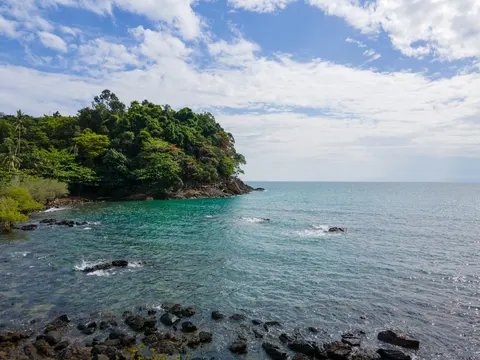
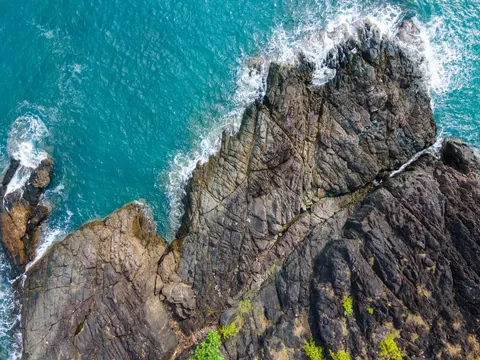
The island’s steep profile is clear from the aerial photographs. Forest comes down close to small coves and rocky headlands, with the highest ground hidden behind the coast. This was the terrain local growers described using. Fields could be placed in valleys and at the edge of plantations, away from the road and the resort strip.
The first grower interviewed had lived on Koh Chang all his life. He described several hundred plants grown in open pollination in a deep valley at about 400 m on the western flank of the interior mountains. He cured the harvest loosely and said the seed had remained on the island. He agreed to provide seed from that population.
His account also placed cannabis inside the island’s recent social history. He remembered a time before the western beaches were developed and described cannabis moving through Trat and Koh Chang during the 1970s and 1980s. Small boats, he said, carried Thai sticks out to larger vessels bound for Hawaii or California. These are one grower’s recollections. They were recorded as oral history and have not yet been checked against another source.
The western side
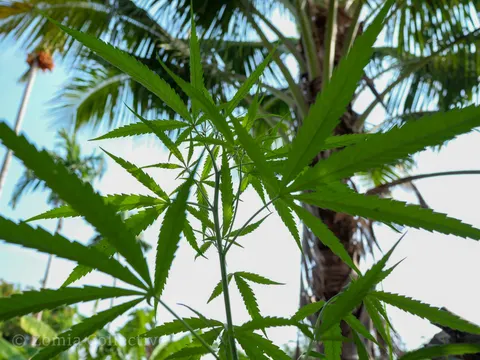
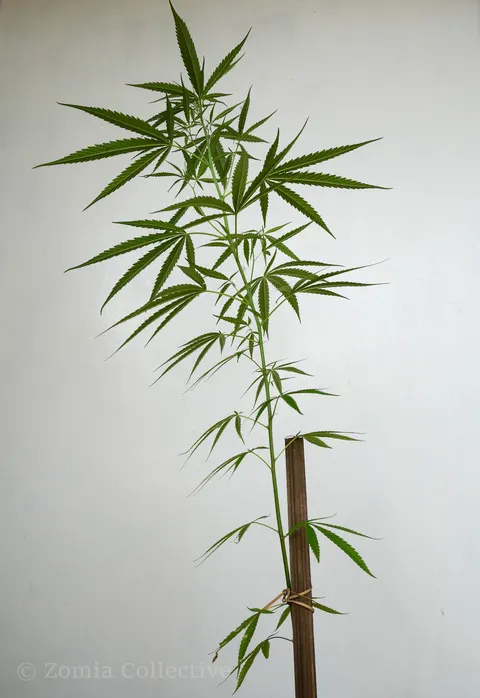
Development has taken much of the accessible ground on the western coast. According to the people interviewed, larger fields had retreated into the interior while garden plants remained around houses. The photographs from the trip show young narrow-leaved plants in domestic settings, under coconut palms and beside walls. They document plants on the island. The present record does not identify which grower held each one.
The eastern side
The eastern side was less developed and received morning and daytime sun on the slopes facing the sea. Local smokers described larger guerrilla grows around the point where rubber plantation met older forest. They eventually introduced the party to a grower willing to talk.
He would not show the field. There were no mature flowering plants ready at that point in the season and he said he needed the seed he held for the next crop. Surplus seed, when there was any, went to friends and family. He asked the party to return after the expected government announcement, when photographs and a longer conversation might be safer.
The refusal is part of the result. The trip established that growers and local seed networks were present, while the field population itself remained beyond direct observation. Any estimate of plant numbers on Koh Chang in the 2022 posts came from local testimony.
Buddha sticks and seed, 9 to 10 March
Locally produced cured cannabis was found near the end of the stay. One sample had been tied into the form usually called a Buddha stick. Éloïse recorded a musky, incense-like aroma and an uplifting effect. The photographs show the same piece from several angles, compact flower bound with red thread.
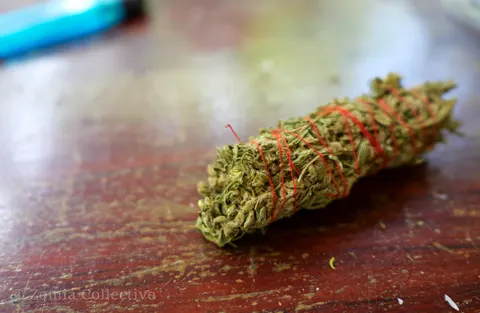
The second field post, published on 10 March, says that about 1,000 seeds from that season’s crop had been delivered the previous day and sent towards France. No accession in the current register carries KOCHANG01. The record therefore supports the delivery and shipment, though it does not establish what happened after that point or whether the seed was ever entered into the collection.
Findings
The expedition confirmed an active local cannabis culture through direct interviews, photographed plants, cured flower and a seed delivery. It also recorded two different pressures on the population. Tourist development had pushed cultivation away from the western coast, while prohibition kept eastern growers cautious about visitors and photography.
The collection record has a clear gap. Seed was said to have been shipped to France, yet no accession was created under this trip. Until Éloïse confirms its later history, the material cannot be tied to a surviving population, stock entry or distribution. The report should remain a draft for the same reason. Its field observations are usable. Its collection outcome is still open.
Cite this report
Cite as ZomiaFR KOCHANG01/koh-chang-2022
Éloïse (2026). Koh Chang, February to March 2022. Zomia Collective. ZomiaFR KOCHANG01/koh-chang-2022. Version 0.1. https://www.zomiacollective.com/expeditions/kochang01/koh-chang-2022
The wikitext landrace.wiki cites this with:
{{cite report |author=Éloïse |date=2026-08-27 |title=Koh Chang, February to March 2022 |publisher=Zomia Collective |url=https://www.zomiacollective.com/expeditions/kochang01/koh-chang-2022 |version=0.1 |id=ZomiaFR KOCHANG01/koh-chang-2022}}